Windows Support Chat

  • Subscribe to our RSS feed.
  • Twitter
  • StumbleUpon
  • Reddit
  • Facebook
  • Digg

Sunday, 22 October 2006

Tips for installing multiple Lotus Notes Client releases on a single system

Posted on 18:46 by Unknown
Bill Buchan has a handy tip on configuring multiple Lotus Notes clients to run on a single workstation, which prompted me to add my own tips on this topic.

This is goodness for those of us (developers, consultants, ISVs, administrators, Help Desk staff, testers, etc) who need to support multiple customers/users running IBM Lotus Notes/Domino at different release levels.

I've been using a similar set-up for many years too. It seems to work quite well, without the considerable overheads and slowdowns that ensue if you choose to install them using a virtualization approach (say, using VMware or Microsoft Virtual PC).

In the following, I'm assuming that "Notes" -- by which I meant the Lotus Notes client, the Lotus Domino Designer, and the Domino Administrator client, rather than the Domino Server -- are being used in a Microsoft Windows environment. This will be the majority (and will probably remain so for quite a few years).

There's a caveat that Bill didn't mention: if you're working on an application that relies upon Windows OLE/COM (say, to interact with and update fields in a Microsoft Word or Excel document) then you can only expect the most-recently-installed version of Notes to behave properly. This is because each successive Notes installation will make changes to the dreaded Windows Registry, such that the only reliable access to the OLE/COM classes will be via the most recent Notes installation.

The versions of Notes that I currently have installed on my main development machine are R5.0.11 and R6.5.4 and (as of a few weeks ago) R7.0.2. (I've only recently decided that it's fairly safe not to bother with actively supporting Notes R4, otherwise I'd have installed R4.6.4 as the very first one. I know of a few places still on R5. Surely there aren't any still on R4?)

I was careful to install them in increasing release number sequence: 5.0.11 followed by 6.5.4 with 7.0.2 being the final install. Naturally, they're all installed in their respective separate Notes and Domino directories.

TIP:
My main reason for writing this article is that there's a check done early in the R6 installation process -- related, I think, to the "multi-user install" option that first appeared with R6.0 -- which can prevent you from installing such consecutive releases on a single system. (Note that, as per Bill's tip, they're all going into separate directories.)

For related background info, including the multi-user support (against a single Notes release) and "roaming user" capabilities, see the following IBM support articles: Unable to Upgrade 4.x or 5.x Single-user Install to a 6 and Is a Multi-user Installation of Notes/Domino 6.x Needed as well as Where is the option for a Multi-user Install of the Notes Client? and also Error: 'You are attempting to upgrade a multi-user installation' when upgrading to a single-user install. There's also the IBM Redbook Upgrading to Lotus Notes and Domino 6 -- download the PDF (or the online HTML edition) and examine Chapter 16.1.2 Multi-user workstations in particular.

Now, you might have arrived at this particular blog posting after doing a search for "Notes and multiple" or something like that. So just to make it crystal clear, I'm not here intending to discuss the ability for multiple users to share the same Notes release on a single workstation, but for a single user (such as a developer, administrator or tester) to run different releases of Notes on the same workstation.


This check didn't happen in the days before R6 came out. And because of the addition of this check, it seems that to accomplish your objective (running multiple releases of Notes on the same workstation) you have to now fiddle with settings in the Windows registry -- some people would call it the Windows "resistry" -- to allow R7 to be installed on top of R6.

The way that I did it after a little trial and error is shown inside the red-colored rectangle in the accompanying illustration. (The blue colored rectangle happens to indicate that multiple versions of the Domino Server are also installed on the same machine.)
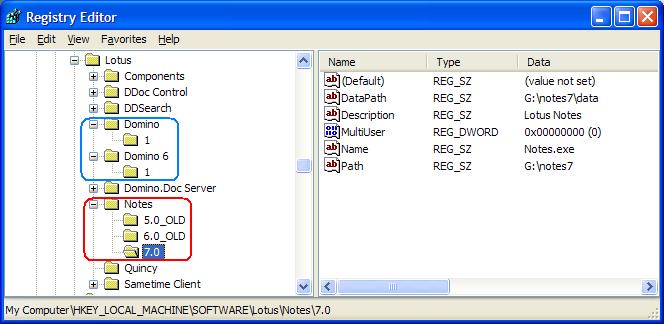


(Click to view a larger image in a new page)
In order to enable R7 to install after R6, I had to experiment for a while, eventually going to the \HKEY_LOCAL_MACHINE\SOFTWARE\Lotus\Notes section of the registry and renaming the folder labelled "6.0" to anything different (I chose the name "6.0_OLD"), after which R7 installed without any further complaints.

After all that, Notes Client and Domino Designer R6.5.4 seems still to work okay. Any comments/suggestions?

UPDATE - 08 January 2007:
I have installed multiple releases once again, on a new desktop system, and this time took the opportunity to document the above procedure more carefully, so you should refer to the following more recent post:
Steps for installing multiple Notes/Domino releases on a single system


AN ASIDE:
If like me you're the only user of Notes on your system, you can try editing the MultiUser doubleword entry, setting it to zero in order to eliminate some minor issues/complications related to this feature.

UPDATE 1:
There's another article on this topic, over at the Lotus Notes FAQ website: Can you keep multiple versions of Notes on the same system? (Note: this older article describes work done with Notes R4 and R5, and the author mentions at the end "I have not had the opportunity yet to try out this procedure involving ND6.")

UPDATE 2:
Here's a tip for installing multiple Notes releases using Citrix AIE (Application Isolation Environment) ... Lotus notes installation in Application Isolation mode

UPDATE 3:
Wolcott Group's Configuration Manager for Lotus Notes may help in this too. "Easily manage the contents of multiple Lotus Notes configuration files on a single system" they say. "Developers typically install multiple versions of the Lotus Notes client on their computer systems so they can develop and test applications on multiple clients. There are often times where a developer will want to review the configuration of the different versions or even compare individual parameters between versions. For developers, CM is most useful when you need to verify (view or set) parameters that were modified by an application or process being tested. Administrators and help desk personnel need to be able to view the differences between a configuration that works properly vs. one that does not." (I've never seen their CM in action, so can't vouch for it one way or the other.)
Email ThisBlogThis!Share to XShare to FacebookShare to Pinterest
Posted in | No comments
Newer Post Older Post Home

0 comments:

Post a Comment

Subscribe to: Post Comments (Atom)

Popular Posts

  • The programmer/developer/coder role is not dead – and long live the project manager!
    It’s no problem being a geek, it would seem, according to Jason Hiner in his ZDNet blog posting The future of IT jobs? It's in three ...
  • I was going to delay writing this, but here it is anyway …
    What’s the difference between ignorance and apathy?    ANSWER: I don’t know, and I don’t care! It’s been one of those days for me, ...
  • The premise is … I’m getting even madder
    I was reading this IBM Redbook today, and it didn’t make a good first impression: I really love IBM Redbooks, but not at all the way...
  • LotusScript and the Curious Case of the "Name previously declared" error
    During final testing of the NotesTracker Version 5.0 (released on 4/4/2007), I was amazed to get an annoying LotusScript error popping up wh...
  • The "Do no harm" principle
    In all my IT work over the decades, I have always tried to abide by the maxim "Do no harm". A subtitle of this post could be: ...
  • Which one is "bigger" -- Microsoft or IBM?
    There's an IT industry debate that has been going on for a decade or more now, about whether or not " The mainframe is dead." ...
  • Windows 7 SP1 upgrade went horribly wrong … NetBeans IDE 7.0 Beta 2, MailWasher and the Christchurch earthquake
    Installing the Windows 7 Service Pack 1 (SP1) on my workhorse desktop system last Saturday turned into a total disaster for me, a really ...
  • IBM invites you... Tune Your Servers!
    IBM's Redbooks are sometimes of considerable to those who don't use IBM software and hardware, one example of which is TCP/IP Tutori...
  • The benefits of ever-decreasing technology size and weight
    This video obviously applies to the old-style PC hardware of the 1980s and 1990s, so presumably newer technology (such as LCD monitors) i...
  • IBM Symphony Plug-ins site has an Achilles’ Heel
    It seems that a weakness of the IBM Lotus Symphony plug-ins site is that not all of the plug-ins are hosted by IBM, and you can suffer tryin...

Categories

  • Add-ons
  • Adobe Reader
  • AJAX
  • Application Platform
  • Architecture
  • AS/400
  • Asia
  • Australia
  • Bad Software
  • Browser
  • Browser Share
  • Bug
  • Bushfire
  • Business
  • Chemistry
  • China
  • Coding
  • Communication
  • Communities of Interest
  • Crossword
  • Crosswords
  • Curiosity
  • Device Drivers
  • DLL hell
  • Documentation
  • Dragon
  • Durian
  • Ecosystems
  • Error Messages
  • Eudora
  • Extensions
  • Facetiousness
  • Failure
  • Firefox
  • FOSS
  • Freelance
  • Freeware
  • Fun
  • Heat Wave
  • Humor
  • i Series
  • IBM
  • IBM Systems
  • IE
  • Image resource manipulation
  • Innovation
  • Installation
  • Internet Explorer
  • Intranet
  • Japan
  • Koala
  • Linux
  • Live Writer
  • Lotus Domino
  • Lotus Notes
  • Lotus Notes Lotus Domino
  • Lotus Software
  • LotusScript
  • Mainframe
  • Melbourne (Australia)
  • Microsoft
  • Multiple
  • Natural Disaster
  • NaturallySpeaking
  • Nigerian 419 fraud
  • Notes Mail
  • NotesTracker
  • Nuance
  • Open Source
  • OpenNTF.ORG
  • Patents
  • POSS
  • PowerPoint
  • Pragmatism
  • Presenter
  • Print Server
  • Project Management
  • Pronunciation
  • Proprietary
  • Registry
  • Releases
  • Research and Development
  • RIA
  • SDMS
  • Security
  • Service Oriented Architecture
  • SNA
  • SOA
  • Software
  • Software Package
  • speech recognition
  • Spell Checking
  • Standards
  • System i
  • System/38
  • TCP/IP
  • Technology
  • Usability
  • Usability Testing
  • Versions
  • Victoria
  • Weather
  • Web 2.0
  • Web 3.0
  • Web Design
  • Web Pi
  • Web Services
  • Webshots.com
  • Windows
  • Windows 7 backgrounds
  • Words
  • z Series

Blog Archive

  • ►  2013 (25)
    • ►  November (1)
    • ►  October (2)
    • ►  September (1)
    • ►  June (7)
    • ►  May (1)
    • ►  April (7)
    • ►  March (2)
    • ►  February (4)
  • ►  2012 (25)
    • ►  December (7)
    • ►  November (1)
    • ►  October (1)
    • ►  September (3)
    • ►  August (1)
    • ►  July (1)
    • ►  June (6)
    • ►  May (2)
    • ►  April (2)
    • ►  March (1)
  • ►  2011 (20)
    • ►  December (3)
    • ►  November (1)
    • ►  August (1)
    • ►  July (2)
    • ►  June (2)
    • ►  March (4)
    • ►  February (2)
    • ►  January (5)
  • ►  2010 (69)
    • ►  November (2)
    • ►  October (3)
    • ►  September (5)
    • ►  August (13)
    • ►  July (3)
    • ►  June (3)
    • ►  May (2)
    • ►  April (10)
    • ►  March (10)
    • ►  February (8)
    • ►  January (10)
  • ►  2009 (41)
    • ►  December (5)
    • ►  November (6)
    • ►  October (5)
    • ►  September (4)
    • ►  August (1)
    • ►  June (1)
    • ►  May (3)
    • ►  April (2)
    • ►  February (9)
    • ►  January (5)
  • ►  2008 (16)
    • ►  November (3)
    • ►  October (3)
    • ►  August (2)
    • ►  July (3)
    • ►  June (1)
    • ►  April (1)
    • ►  February (1)
    • ►  January (2)
  • ►  2007 (39)
    • ►  October (1)
    • ►  September (1)
    • ►  August (1)
    • ►  July (5)
    • ►  June (1)
    • ►  May (2)
    • ►  April (11)
    • ►  March (5)
    • ►  February (8)
    • ►  January (4)
  • ▼  2006 (98)
    • ►  December (8)
    • ►  November (25)
    • ▼  October (6)
      • Recommending ... Paint.NET
      • Tips for installing multiple Lotus Notes Client re...
      • Web 2.0 approaches
      • Programmer -- or Developer?
      • asiapac.com.au Browser Share - as at October 2006
      • A perspective on Lotus Notes views
    • ►  September (6)
    • ►  August (5)
    • ►  July (6)
    • ►  June (16)
    • ►  May (17)
    • ►  April (2)
    • ►  March (4)
    • ►  February (3)
  • ►  2005 (38)
    • ►  November (5)
    • ►  September (2)
    • ►  August (10)
    • ►  July (14)
    • ►  June (3)
    • ►  April (3)
    • ►  March (1)
Powered by Blogger.

About Me

Unknown
View my complete profile